
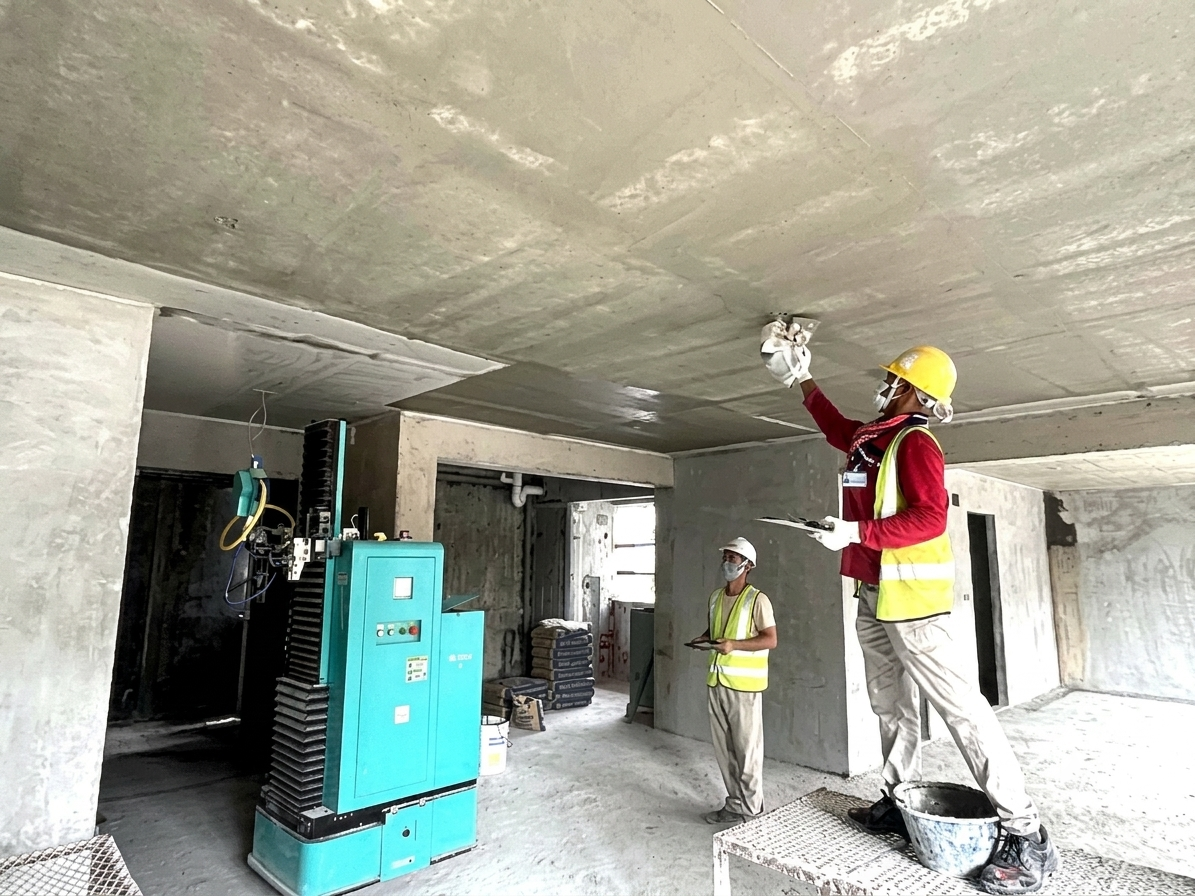
For construction contractors in Southeast Asia, the rainy season is not only a weather challenge. It often becomes a schedule challenge, a labor challenge, and a productivity challenge.
Heavy rainfall can slow down outdoor work such as facades, roofing, roads, open yards, and exposed concrete areas. But project deadlines do not always move with the weather. When outdoor progress becomes uncertain, contractors usually need to recover time in the work zones that remain controllable: interior finishing, indoor flooring, basements, parking garages, warehouses, factories, and other covered construction areas.
This is where construction robots can offer practical value. They are not designed to make bad weather disappear. Their real role is to help contractors keep repetitive work moving, reduce dependence on large manual crews, and improve consistency in indoor or semi-indoor construction tasks.
For project owners, general contractors, subcontractors, and technical procurement teams, the key question is not “Which robot looks the most advanced?” A better question is: “Which construction robot can solve a real bottleneck on my jobsite during the rainy season?”
1. Wall Finishing Robots for Interior Schedule Recovery
Wall finishing robots are often one of the most useful choices for rainy-season construction projects. When exterior work slows down, interior finishing becomes a practical way to protect the schedule.
Ideal Work Sites
In Southeast Asian projects, wall finishing work is common in:
-
Apartments and hotels
-
Hospitals and schools
-
Office buildings
-
Underground parking garages and basements
-
Corridors and public buildings
These spaces usually include large areas of repeated wall and ceiling surfaces, which are suitable for robot-assisted construction.
Wall finishing is also highly labor-intensive. In hot and humid conditions, manual labor can be tiring, dusty, and difficult to keep consistent across long working hours. Key tasks that require repeated movement and stable workmanship include:
-
Putty spraying
-
Scraping and sanding
-
Dust collection
-
Primer application
-
Paint spraying
Expected Output & Efficiency
A wall finishing robot can help turn these tasks into a more controlled workflow. The robot handles large-area repetitive surface work, while workers focus on preparation, masking, material supply, edge repair, inspection, and final touch-up.
For contractors, the biggest value is predictable daily output. In suitable large-area applications, some wall finishing systems can reach several times the efficiency of traditional manual work. Different spraying robot models can also cover standard residential interiors as well as higher commercial spaces, with working heights such as 3.2 m, 4.6 m, and 6 m depending on the model.
This makes wall finishing robots especially relevant for contractors searching for solutions such as interior wall painting robot, wall finishing robot, robotic sanding, robotic putty spraying, and automated wall painting for large buildings.
Key Takeaway: The best fit is a project with repeated layouts, open indoor work zones, large wall areas, and stable material supply. The robot is less suitable for very small rooms, heavily blocked spaces, or walls that require major repair before finishing begins.
2. Floor Tile Laying Robots for Large Indoor Flooring
Floor tile laying robots are useful when a project has large, repeated, and relatively open indoor floor areas.
Ideal Work Sites
Typical applications include:
-
Hotels and apartments
-
Shopping malls
-
Airports
-
Hospitals and schools
-
Public buildings and commercial corridors
During the rainy season, indoor flooring often becomes a key recovery area. If outdoor work is delayed, project managers may need to accelerate interior construction. But tile installation depends heavily on skilled labor, layout accuracy, joint consistency, and smooth material coordination. When skilled workers are limited, flooring can quickly become a bottleneck.
Expected Output & Efficiency
A tile laying robot can reduce repetitive manual handling and support more consistent tile installation across large areas. It does not remove the need for workers. Instead, it changes the crew structure. Workers still prepare the base surface, supply tiles and adhesive, handle edges and corners, check alignment, and complete detailed finishing work.
For reference, some floor tile laying robot systems are designed for large-scale construction efficiency of around 100–120 m² per day and may reduce the need for several manual workers under suitable conditions. The actual output still depends on tile size, floor preparation, site layout, material supply, and the amount of edge work required.
For contractors searching for tile installation automation, floor tile laying robot, robotic tile paving, or construction robots for large indoor flooring, this type of equipment can be a strong option when the project has enough repeated work and a clear installation plan.
Key Takeaway: Contractors should not judge a tile laying robot only by its maximum speed. The real question is whether the site has enough continuous floor area for the machine to work efficiently. A hotel corridor or airport zone is usually more suitable than a small unit divided into many narrow rooms.
3. Laser Ground Leveling Robots for Covered Concrete Floors
For rainy-season projects, concrete work needs a careful approach. Robots cannot solve problems caused by exposed rain, poor site protection, or unsuitable ground conditions. However, in covered or semi-covered spaces, laser ground leveling robots can help contractors maintain progress on concrete floor packages.
Ideal Work Sites
Suitable applications include:
-
Warehouses and factories
-
Logistics centers
-
Basements and underground parking garages
-
Industrial floors and large commercial buildings
These projects often involve large floor areas, limited working windows, and strict requirements for flatness and surface quality. Concrete floor leveling is physically demanding and time-sensitive. Once concrete is placed, the crew must complete the work within a limited period. Delays or inconsistent manual work can lead to flatness problems, surface defects, rework, and extra cost.
Expected Output & Efficiency
A laser ground leveling robot can support a more stable floor construction workflow. Laser positioning helps improve leveling accuracy, while robotic operation reduces the pressure on manual crews during large-area concrete work.
Under suitable site conditions, some laser ground leveling systems are designed for around 200–300 m²/h, while larger four-wheel laser leveling systems can reach higher output ranges such as 400–600 m²/h. Some systems may also reduce the need for two to five manual workers, depending on the model and jobsite conditions.
This type of robot is especially relevant for searches such as laser ground leveling robot, concrete laser leveling robot, robotic concrete floor leveling, warehouse floor construction, factory floor leveling, and parking garage concrete floor construction.
Key Takeaway: For project managers, the benefit is straightforward: better control over large covered floor areas and more predictable progress when the rainy season affects other parts of the project. Key evaluation points should include floor area, site preparation, laser positioning stability, and after-sales support.
How Contractors Should Choose the Right Robot
The best construction robot depends on the project stage and the work package.
-
Entering interior finishing: Wall finishing robots are often the first option to evaluate.
-
Main schedule pressure is indoor flooring: Floor tile laying robots may deliver greater value.
-
Working on covered structures: Laser ground leveling robots help maintain progress in concrete floor areas.
Before purchasing, contractors should ask six practical questions:
-
How much repeated work is available?
-
Is the work area open enough for robotic operation?
-
How high is the local labor cost?
-
Can the machine be used across multiple projects?
-
Can the crew be trained quickly?
-
Will the supplier provide deployment support, spare parts, and after-sales service?
Payback depends less on the machine alone and more on utilization. A robot used only occasionally may not create strong returns. A robot used across several similar projects can become a long-term productivity asset.
Final Thoughts
For Southeast Asian contractors, rainy-season planning will always require flexibility. The most useful construction robots are not necessarily the most complex machines. They are the ones that fit real jobsite workflows, reduce labor pressure, improve construction consistency, and help teams keep indoor and covered work moving when outdoor progress becomes uncertain.
If you are planning a construction project in Southeast Asia, the best starting point is not simply choosing a robot model from a catalog. Start with your work area, project stage, labor cost, schedule pressure, and site conditions. With the right project information, a suitable construction robot solution can be matched to the real needs of your jobsite.
